

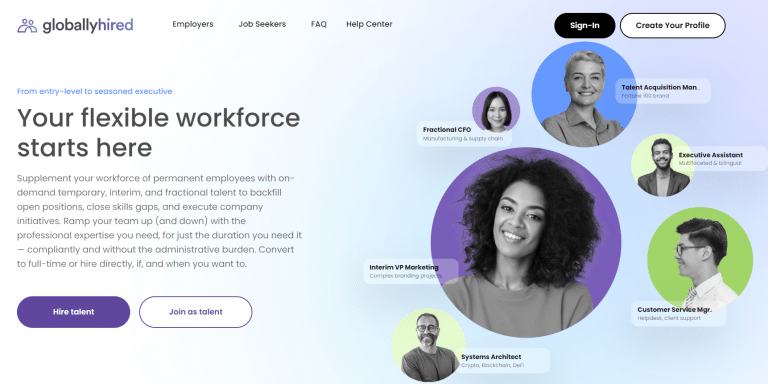
Before using GloballyHired in 2026 or budgeting for it in 2027, verify the current service, availability, fees, terms, and support directly. Earlier descriptions of a free employment network should not be treated as current pricing or proof of results. This review provides an employer evaluation framework and identifies the claims that still need confirmation.
Reviewed October 26, 2026. We could not reliably retrieve current product information from the linked GloballyHired website during this review. That does not establish that the service has closed or is unavailable to every user. It means this article cannot independently confirm its present features, account access, pricing, or candidate inventory.
What this updated review can establish
The earlier article described GloballyHired as an employment network connecting employers and candidates and linked to globallyhired.com. It also used broad promotional claims about cost, ease, and hiring value. Those historical descriptions do not verify the product a new customer would receive today.
This revision does not present a hands-on account test, a current price quote, a measured comparison with other providers, or verified customer outcomes. It offers a practical way to evaluate the service if you can obtain current documentation. Keep the provider’s written answers and compare them with the work your organization actually needs done.
If you encounter a similarly named website, confirm the legal provider and exact domain before assuming it is the same service. Search results can combine unrelated recruiting, staffing, employer-of-record, and job-board products. A familiar name is not enough to establish identity, ownership, geographic coverage, or the terms governing an account.

Define the hiring problem before evaluating a platform
Write down the vacancy, location, employment type, compensation information, essential responsibilities, and intended hiring process. Then identify the problem you want a tool to address. Publishing an advertisement, finding potential candidates, managing applications, and administering employment are different tasks. One product may address some of them without replacing the others.
A small nonprofit might need a clear application route for one vacancy. Another employer may need several users to coordinate candidate communication. A third may be evaluating temporary staffing support. Describe the required task before comparing product labels. Otherwise, an attractive feature list can distract from the actual operational need.
Review whether the role itself is ready to recruit. Unclear duties, an unworkable schedule, or compensation outside the available candidate market can affect results regardless of the software. Foundation List’s job posting checklist can help prepare the opportunity before you spend time evaluating another channel.
Ask what the current service includes
Request a current description of the employer workflow. Can an employer publish a job, search profiles, contact people, manage applicants, schedule interviews, or export records? Ask which functions are included in the proposed account and which require an additional service. Do not assume an older screenshot or article describes the current interface.
Clarify what the provider does and what your team must do. A searchable profile database is different from a recruiter conducting outreach. An application form is different from an applicant tracking system with your required permissions and records. A staffing engagement is different from a software subscription. Use the written agreement to establish the service boundary.
For any demonstration, ask the provider to show a realistic task from beginning to end. For example, publish a fictional vacancy, review a sample application, send a test message to an approved test account, and explain how the record is retained. Avoid using real applicants’ information for an unapproved demonstration.
Verify pricing in writing rather than relying on free language
Ask for the complete current fee schedule and the event that triggers each charge. Separate account access, job publication, candidate contact, subscription renewal, placement, payroll, and optional services where relevant. The ability to create a profile without payment does not establish that the entire hiring process is free.
- What is included in the quoted plan or service?
- Are there limits on users, postings, searches, contacts, or duration?
- What creates an additional charge, and who can authorize it?
- Does the agreement renew automatically, and how is it cancelled?
- What happens to records and access when the account ends?
For budget comparison, include staff time as well as provider fees. A lower subscription price may require more manual work; a broader service may include tasks you do not need. Do not assign a value to a promised feature until the provider confirms it is available under the terms you are considering.
Investigate candidate access and relevance
Ask how profiles enter the service, how availability is updated, and what employers can infer from a listed profile. A large total user count does not tell you how many people are relevant to your location, responsibilities, compensation, or schedule. An account can contain information that is no longer current.
Define a small set of role-related criteria for a demonstration. Ask the provider to explain the results without sharing unnecessary personal information. Determine whether the search finds people who have expressed current interest, public profiles, past applicants, or another category. These sources have different practical implications for outreach.
Do not describe a person as verified, screened, qualified, or available unless you know what that label means and what was actually checked. The employer still needs its approved assessment process. A profile, score, badge, or automated match should not be presented as a guarantee that someone can perform the role.

Review privacy and candidate communication before uploading data
Obtain the current privacy notice, service terms, security information, and any required data agreement. Ask what information is collected, who can access it, how long it is retained, and how deletion or export works. Identify whether the provider uses uploaded information for other purposes and how those terms affect your organization’s intended use.
Use your organization’s approved review process before uploading resumes, interview notes, identity documents, or other sensitive material. Do not assume a candidate’s application to your organization authorizes every possible external use. Ask the appropriate reviewer to evaluate permissions, notices, records obligations, and vendor terms for the actual workflow.
Give candidates a clear explanation of where to apply and how communication will occur. If the process sends them to another service, make that transition understandable. Provide a contact route for questions and avoid requiring people to repeat the same information across several systems without a practical reason.
Check accessibility and support with real tasks
Review whether the application route can be completed with the access features your process requires. Ask about keyboard navigation, readable instructions, document formats, and support for applicants who encounter a barrier. A provider’s general statement should be followed by a practical review of the workflow you intend to use.
Identify who responds when an applicant cannot submit a form or an employer cannot access records. Confirm support channels, coverage, escalation, and any response commitments in the agreement. Do not convert an informal sales assurance into a service-level promise that the provider has not accepted in writing.
Plan an alternative contact route that your team can actually support. If the system is temporarily unavailable, applicants should know how to ask for assistance. The employer also needs a process for recording the inquiry and handling it consistently rather than losing it in an individual’s inbox.
Evaluate AI features as specific functions
If a current product demonstration includes AI, ask exactly what it does. Drafting text, extracting resume fields, recommending profiles, ranking applicants, and making an employment recommendation are different uses. Ask which information the system relies on and whether the employer can inspect, correct, or disable the function.
Do not approve a feature merely because it is labeled modern or intelligent. Review it against the hiring purpose, information policies, accessibility needs, and applicable requirements. Keep accountable people responsible for employment decisions. A vendor’s marketing description does not establish accuracy, fairness, or suitability for your vacancy.
For a broader planning resource, the NIST AI Risk Management Framework offers an official route. Use its current materials to support a structured discussion with the appropriate reviewers. It is not a certification that a particular hiring product is approved or a substitute for evaluating your actual use.

Run a limited pilot with a decision in mind
Choose one defined vacancy or a fictional workflow demonstration and agree on what you need to learn. Set a time limit, spending limit, responsible owner, and stop conditions. Do not upload your entire candidate history merely to discover whether a basic feature meets your needs.
Useful pilot observations include whether the posting was accurate, the application route worked, relevant inquiries reached the team, users could perform assigned tasks, and records could be retrieved. Record problems and the provider’s response. These observations describe the pilot; they do not prove how every future vacancy will perform.
When comparing channels, use consistent definitions. An impression, application, relevant application, interview, and accepted offer are different stages. Keep duplicates and source attribution in mind. A small pilot may identify a practical issue without supporting a claim that one product is statistically superior to another.
Compare alternatives by the task they perform
A job board can distribute a defined vacancy. An applicant tracking system can organize parts of the application process. A recruiter may provide sourcing and assessment services under an engagement. Temporary staffing and employer-of-record arrangements involve additional responsibilities and terms. Do not compare these products as though they are identical substitutes.
Foundation List offers job posting options and a nonprofit jobs search. This article appears on Foundation List, so those links describe our own service routes rather than an independent ranking. Review their current information against your needs just as you would another provider.
For broader channel research, use the job-board resource collection. Compare audience, function, cost, access, and the work your team must perform. Avoid assuming that adding another channel will resolve a problem caused by the role’s duties or employment terms.
Questions job seekers should resolve before signing up
Confirm the provider’s identity, current terms, privacy choices, and what creating a profile allows others to see. Ask how to update or remove information and how employer contact works. Use the official service route and avoid assuming that a message using the product’s name is authentic.
Evaluate any opportunity separately from the platform carrying it. Confirm the employer, role, compensation information, application process, and contact details. A listing’s presence does not establish that the platform has verified every claim or that the position remains open. Keep records of the information you receive.
The nonprofit job search checklist can help organize applications and follow-up. Choose where to invest time based on current opportunities and your goals. A new account may be one research option, but it does not guarantee contact, interviews, or employment.
Frequently asked questions
Is GloballyHired currently free for nonprofit employers?
This review could not verify current pricing. Ask the provider for written terms covering account access, postings, contacts, renewals, and any other relevant services before relying on earlier free-service claims.
Has GloballyHired closed?
We cannot establish that from an unsuccessful website retrieval. Confirm current availability and account support directly rather than interpreting a technical access problem as proof of closure.
Was this a hands-on product test?
No. This revision identifies the limits of current verification and provides an evaluation framework. It does not claim an account demonstration, measured outcomes, or independently verified customer results.
What should an employer verify first?
Provider identity, current service scope, availability, complete pricing, terms, candidate access, privacy, and support. Then test the workflow against a defined hiring need.
Does an AI match replace an employer’s assessment?
No. Review what the feature does and keep an appropriate human assessment and decision process. A score or recommendation does not establish that a person is suitable for the job.
How should this inform a 2027 budget?
Use a current written quote and confirmed scope. Include implementation and staff time, assign an owner, and treat unverified features or prices as unresolved assumptions.
Explore the next step for your work
Employers can review posting options for a defined vacancy. Job seekers can explore current nonprofit opportunities and compare the duties and terms of individual roles.